


IHAI Just Put A Price Tag On All 22 Of Its Battery Patents

When we last talked about Premergy (OTCID: $IHAI), the company held 22 granted patents on the control layer above battery chemistry, and the open question was what anyone would pay for them. The industry has been making the case on its own, since Tesla (NASDAQ: $TSLA) earns better margins selling stored electricity than it does selling cars, and Ford (NYSE: $F), LG Energy Solution (KRX: 373220) and Samsung SDI (OTC: $SSDIY) are converting EV manufacturing capacity to chase the same spread. IHAI has now put out its own answer, publishing what it intends to charge in three markets while its litigation counsel pursues companies it says are using the architecture without paying.
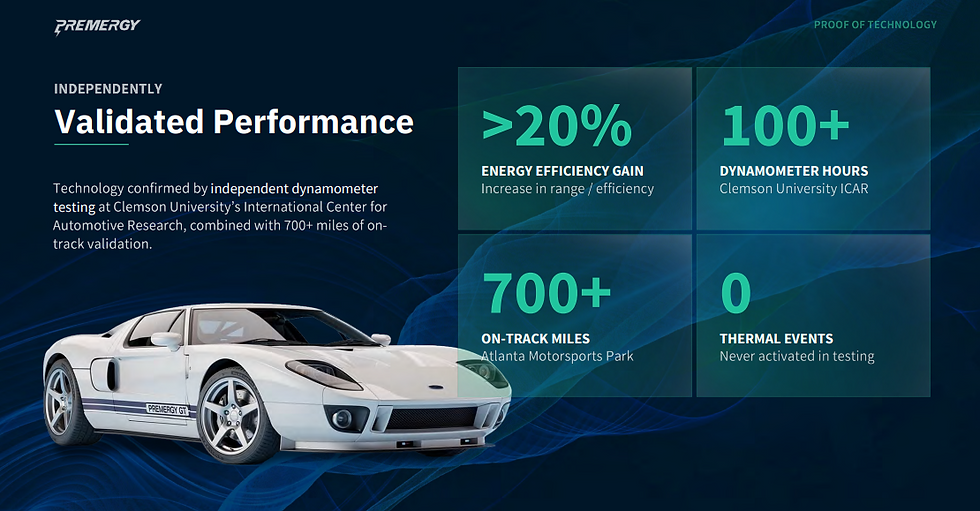
The story starts with electric vehicles, where Clemson University's International Center for Automotive Research ran the system past 100 dynamometer hours, two further years of Atlanta track testing added 700 miles, and the program returned better than 20% more range from the same cells. The system splits the pack into two banks of different chemistries, one built to cruise and one built to surge, and a controller hands the load to whichever bank the moment calls for. The regeneration family drops pack voltage to match whatever the slowing motor puts out, and the company says that captures charge from speeds as low as 5 mph, the parking-lot crawl conventional systems throw away. The prototype's thermal protection never activated across the entire program, because splitting the load keeps either bank from cooking, and the cooling hardware that guards a conventional pack runs 10% to 20% of the bank's cost. An automaker licensing this advertises the extra range, deletes componentry worth a tenth to a fifth of its most expensive assembly, and sheds the warranty exposure that heat builds into an 8 to 10 year battery guarantee. IHAI sizes that market at $15.1 billion, and it is only the slowest-moving of the three.
Drones move faster and feel the tradeoff harder, since a commercial pack buys a working airframe 45 to 60 minutes in the air and every gram of added battery subtracts a gram of camera or cargo. Preliminary analysis projects a 15% to 25% endurance gain from the dual-bank split plus charge recovered on descent and hover. Discussions with multiple drone and UAV manufacturers opened in July, with the Clemson program now running UAV-specific battery and charging work to support them, and a drone maker can qualify and ship a component in months where an automaker needs years. Defense procurement already pays premiums for endurance that commercial fleets treat as a wish-list item, and the $4.7 billion vertical is the smallest of the three but the one most likely to produce the first signed agreement while the largest of the three waits behind it.
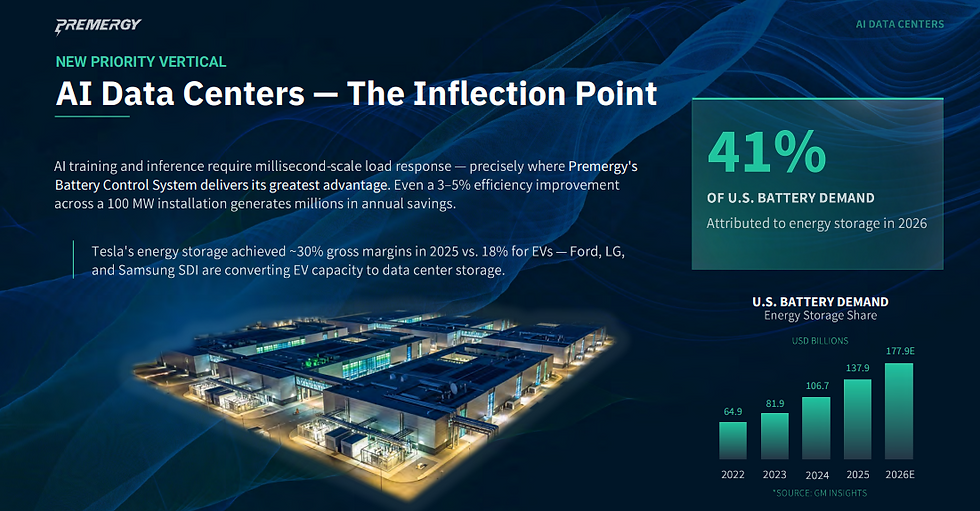
Data centers are that largest market, running the same controller across thousands of modules at once while AI training slams their load between idle and full draw in milliseconds. Chemistry cannot respond at that speed, but switching hardware can, and the granted claims describe batteries wired in series to discharge and rewired in parallel against a generator to recharge, which is how a hall running UPS strings beside standby generators is already built. A 3% to 5% efficiency gain across a 100 megawatt facility returns millions of dollars a year, which is why IHAI sizes this vertical at $17.3 billion, larger than automotive, and calls it the priority. Tesla ran its storage business at roughly 30% gross margins last year against 18% on its cars, and energy storage will take 41% of US battery demand this year against 26% two years ago, roughly $73 billion of a $178 billion market. The battery makers converting capacity to chase that spread are not competitors here, since the patents on that layer sit with IHAI rather than with any of them, and every gigawatt-hour they redirect grows the installed base a license would cover.
Every unit of that installed base has a published price on it, because IHAI has already put out its rate card, a rarity at this stage: $50 to $500 per vehicle or aircraft, $5 to $25 per kilowatt-hour under management, and a software subscription per site or per megawatt, all labeled conceptual. The per-unit math compounds, since a single 100,000-unit vehicle program pays $5 million to $50 million and pays it again every model year the technology stays in the platform. The capacity math concentrates, since one 100 megawatt data center running four hours of storage holds 400,000 kilowatt-hours and writes a $2 million to $10 million license for a single facility. At the top of that range, one building pays more than IHAI's entire market capitalization, which sits just over $8 million.
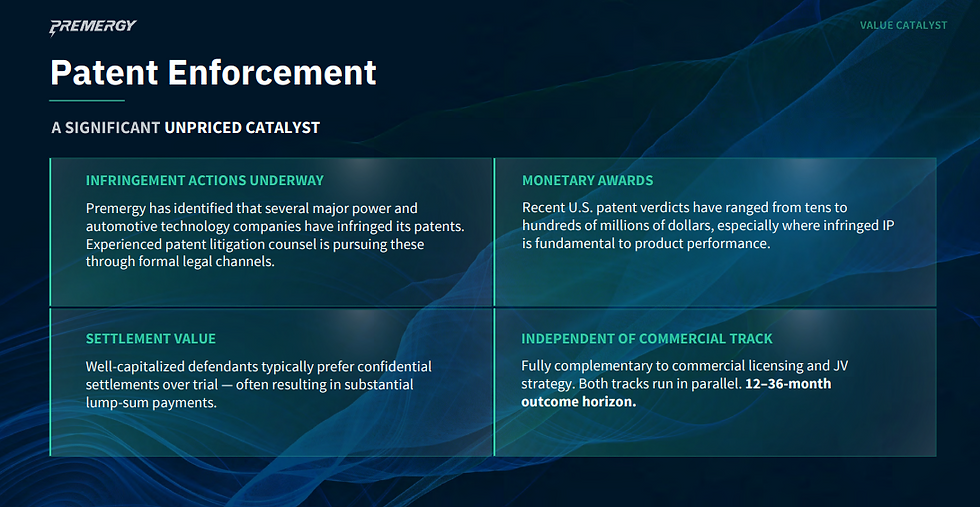
But what's even more interesting than the pricing model itself is that some of that money may already be owed. IHAI states that several major power and automotive technology companies run its dual-bank switching and regenerative routing inside commercial products today, and that its patent litigation counsel is pursuing them through formal channels on a 12 to 36 month horizon the company calls a largely unpriced asset. A settlement or a forced license lands on the income statement the same way a negotiated one does, and it arrives without waiting on a procurement cycle, which makes enforcement the one track that skips the sales process entirely.
The roadmap calls for 2 to 3 pilot agreements inside 6 months and the first commercial license inside 12, with enforcement running beside it on a clock of its own. Automotive is validated, drones are in live discussions, data centers are priced, and either track can produce the first deal, whose royalty rate becomes the benchmark for everything signed after it. Reaching the next market costs IHAI nothing extra after that, because an asset-light licensor never builds a factory, and the buildout creating the opportunity is funded by the margin gap on Tesla's own income statement.
Disclaimer: Mt. Zion Market Ventures has received compensation for the creation and dissemination of this article. For more information, please visit opendisclose.com. The information provided here is not intended to be a comprehensive analysis of the subjects mentioned. All information, opinions, and forecasts contained herein should not be construed as investment advice, a recommendation, or an offer to buy or sell any securities or related financial instruments. Investors should conduct their own research or consult with a qualified financial advisor before making any investment decisions. The author and publisher of this content are not responsible for any losses, damages, or other consequences that may result from the use of the information provided. Investing in stocks, including those mentioned here, involves risks, including the risk of loss.


